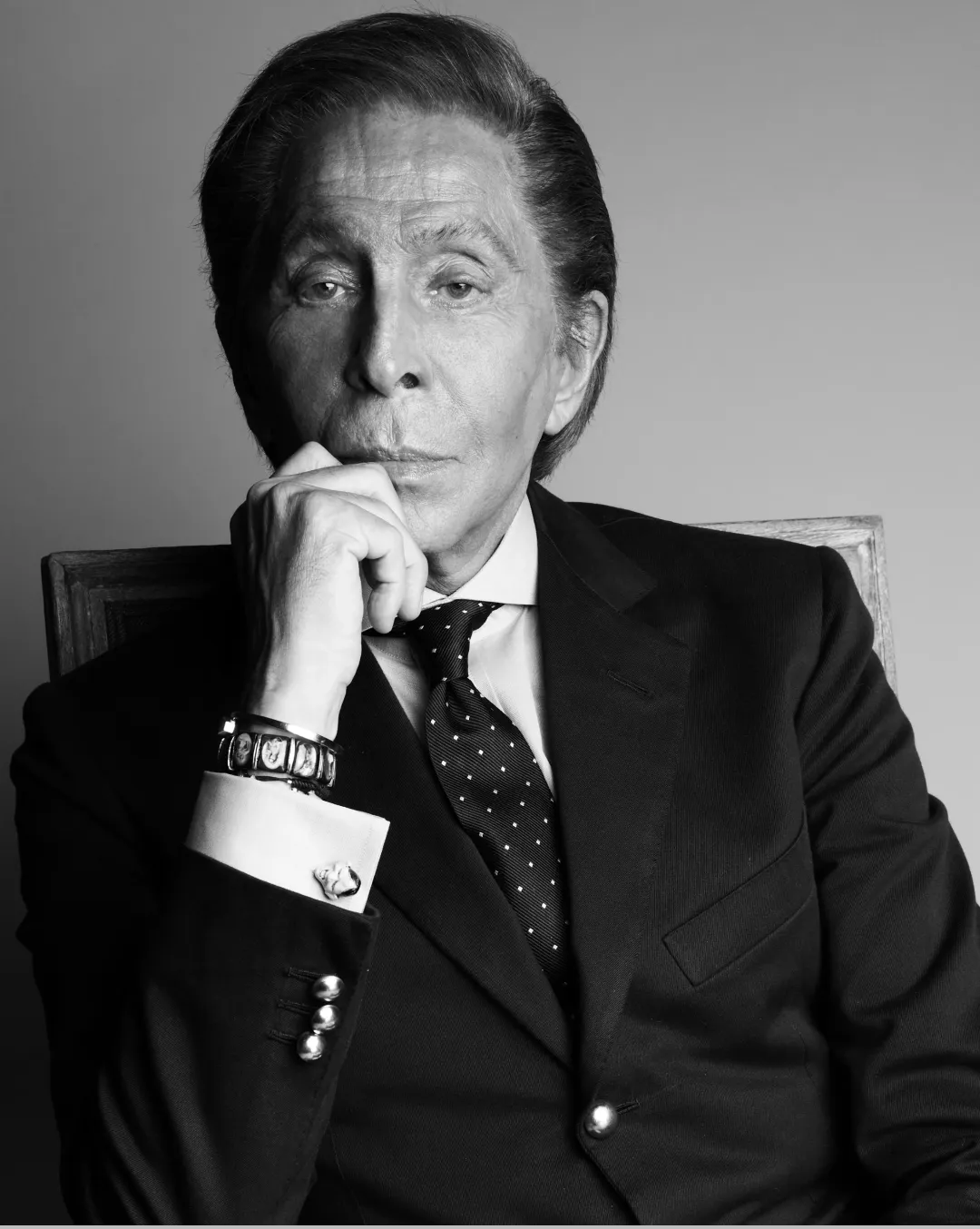
Valentino Garavani (1932–2024)
2 minute read
Fashion
Design
Written By Murray Crane
Valentino Garavani belonged to a generation of Italian designers for whom elegance was not a concept but a discipline. His work was rooted in the traditions of Italian tailoring, refined through Roman couture, and ultimately consolidated in Milan as Italy’s industrial and cultural centre of fashion. While his name became synonymous with red carpet glamour, the foundations of his house were built on cut, proportion and an unshakeable belief in craft.
Though Valentino showed in Rome and dressed the world’s most visible women, Milan mattered. It was where Italian fashion matured into a global industry, and where the language of Made in Italy was codified: precision manufacturing, specialist ateliers, disciplined supply chains and a respect for materials that bordered on reverence. Valentino’s menswear, in particular, reflected this Milanese clarity. His suits were never loud. They were exacting, beautifully balanced and quietly authoritative.
Italian tailoring has always prized ease over display, and Valentino understood this instinctively. Jackets were structured but never rigid. Trousers sat cleanly, without excess. Fabrics were chosen for how they moved and aged, not how they photographed. This was luxury defined by longevity rather than novelty, and it placed Valentino firmly within the lineage of Italian menswear rather than above it.
At a time when fashion increasingly rewards disruption, Valentino’s contribution was continuity. He preserved standards that many houses abandoned: consistency of cut, respect for the wearer, and the idea that clothes should enhance rather than announce. His Milan-made menswear embodied the values that made Italian fashion globally credible in the late twentieth century — not spectacle, but trust.
Valentino retired before the industry accelerated into constant reinvention, and perhaps that timing was deliberate. His work belongs to an era when fashion houses were built slowly, designers stayed close to their ateliers, and Made in Italy was a promise rather than a slogan.
He leaves behind more than an archive of beautiful clothes. He leaves a template for how Italian menswear can be elegant without excess, luxurious without ostentation, and modern without abandoning its roots. Milan, and Italian fashion more broadly, is poorer for his absence, but richer for the standards he set.