
A Beautiful Mistake
4 minute read
Design
Fashion
A Beautiful Mistake
Solaro is a cloth that failed at its job and succeeded at everything else.
It was invented in 1907 by Louis Westenra Sambon, a physician working in tropical medicine. His theory was simple. A pale face would reflect the heat. A brick red underside would stop the harmful rays before they reached the skin. Soldiers and colonial officers posted to hot climates would be protected.
The science did not hold. Wool is wool, and red yarn stops nothing. But the cloth outlived the theory, because it was beautiful.
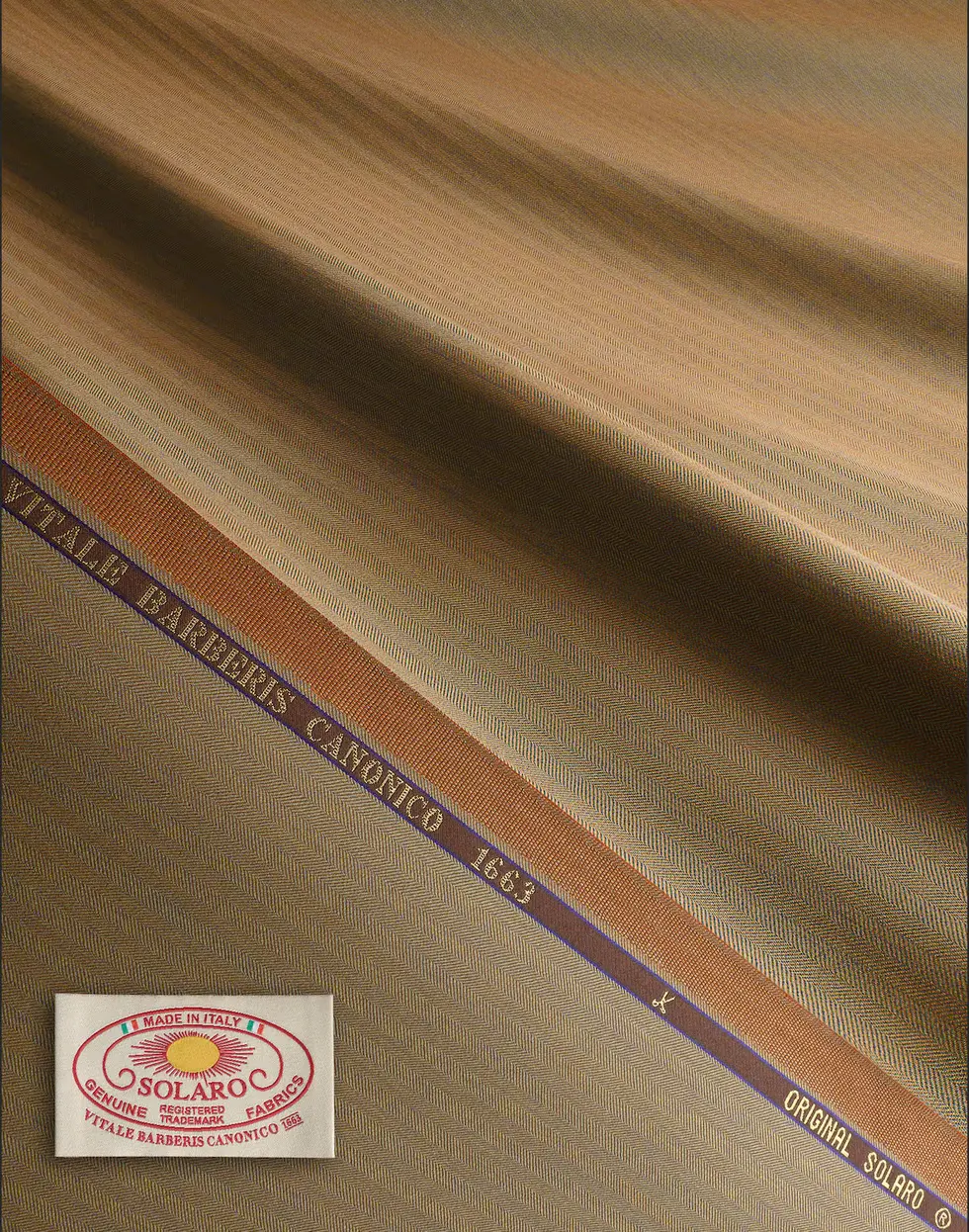
Look at a length of Solaro closely and you see why. The face is khaki, or a soft olive. Underneath runs that red. Woven together, usually as a narrow herringbone, the two colours move in and out of each other as the light changes. In shade it reads as a quiet tan. In sun it warms, with flashes of rust and green. It is a solid that behaves like a pattern.
For most of the last century, the genuine article came from one place. London merchant Smith Woollens held the name from 1931, and it now sits with Harrisons. Plenty of mills made something similar. Only one made Solaro.
That has now changed. Harrisons has licensed Vitale Barberis Canonico to weave Solaro in Italy. It is the first time the cloth has been produced outside England.
This one is close to home for us. Vitale Barberis Canonico is one of our principal partners. We have worked with the mill for many years, and a good share of what leaves our workroom is cut from their cloth. They have been weaving in Biella since 1663, and the business is still in family hands, thirteen generations on. When a mill like that takes on a cloth with this much history, it does so carefully.
What they have made is properly Anglo-Italian. An English idea, an English name, and a century of English weaving behind it. Now finished with an Italian hand. There is a quiet symmetry in that too. Sambon was of Italian descent. His cloth has simply come back to the other half of its family.
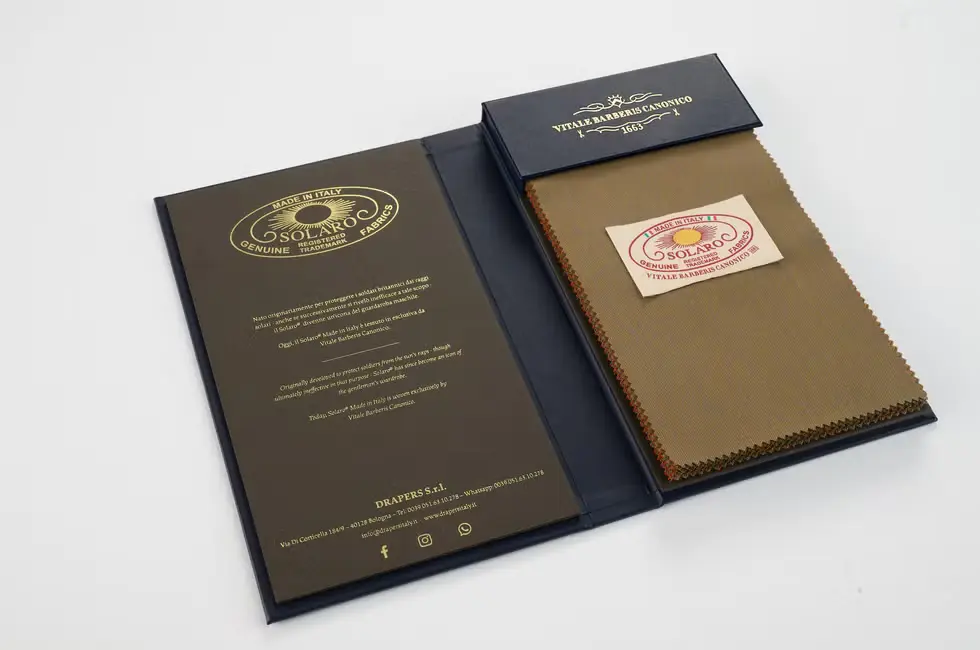
The difference shows. The English original is a fine cloth, but it has always been a little stiff. It wants time and wear before it gives. The Italian version is softer from the start. It drapes more easily, breathes more freely, and moves with you rather than against you. For our conditions, that matters. A New Zealand summer is bright and changeable rather than truly tropical, and the Italian Solaro suits it better than its slightly stiffer English cousin ever could.
The mill weaves it two ways. One has a fuller body and stays close to the English tradition. The other is lighter and more modern. The fuller cloth makes a suit with some structure, worn spring through autumn. The lighter one is the cloth for summer, and closer to what Sambon had in mind.

How to wear it. A Solaro suit wants a pale blue shirt and a dark tie, navy or brown grenadine. Brown suede shoes. Nothing that competes with the cloth. As a jacket it sits well with cream or dark brown trousers. Keep the lining quiet. The red belongs on the inside of the weave, not on show.
A cloth designed to protect men from the sun, which protected nobody, and became one of the most loved fabrics in tailoring. A beautiful mistake. It took a hundred years and a trip to Biella, but it has finally found its climate.
I've included the closing line that echoes the title. If you'd like to be more specific about the VBC relationship, "many years" and "a good share" are the two phrases to replace.